
What Happens If You Misclassify Your Employees vs. Contractors
- Kim Yurosko

- Sep 26, 2025
- 5 min read

When it comes to managing your workforce, one of the most dangerous mistakes a business owner can make is misclassifying employees as independent contractors. In California, where labor laws are among the strictest in the nation, the consequences can be severe. Misclassification can trigger IRS audits, hefty penalties, back wages, lawsuits, and even criminal liability.
According to the National Employment Law Project, 10 to 30 percent of employers nationwide misclassify their workers. Whether intentional or accidental, getting it wrong can cost your business thousands. Let’s break down what you need to know to protect your company, especially here in California, and how KY Tax Service & Bookkeeping can help you stay compliant figuring out What Happens If You Misclassify Your Employees vs. Contractors
Why Worker Classification Matters More Than Ever
As the gig economy grows and remote work becomes the norm, businesses increasingly rely on contractors. But there’s a fine legal line between a legitimate 1099 contractor and a W-2 employee. Misclassifying the two not only violates labor and tax laws but also exposes your company to government audits, lawsuits, and employee claims.
High-profile companies like FedEx and Uber have paid millions in settlements due to misclassification lawsuits. If it can happen to them, it can happen to anyone.
To better understand the risks, you first need to understand the legal definitions.
W-2 Employee vs. 1099 Contractor: What’s the Legal Difference?
Defining Employees Under IRS and California Law
A W-2 employee is someone who works under the control of the business. The company:
Sets their schedule
Provides the tools and training
Withholds taxes and provides benefits
Pays into unemployment and workers' compensation insurance
Employees are covered by wage and hour laws, including minimum wage, overtime, and rest breaks.
What Qualifies Someone as an Independent Contractor
Independent contractors, on the other hand:
Work independently without supervision
Use their own tools and equipment
Control how and when the work is done
Are paid per project or by invoice
Receive no benefits or tax withholdings
Understanding the difference is crucial not just for compliance, but for avoiding major financial consequences.
For more detail, the IRS provides a full breakdown of how to classify workers.
What Happens If You Misclassify Your Employees vs. Contractors: The Three Classification Tests Every California Business Must Know
The IRS Common Law Test
The IRS uses three broad categories to assess classification:
Behavioral Control: Does the business direct how the work is done?
Financial Control: Does the business control the economic aspects, such as equipment or expense reimbursement?
Relationship Type: Is the relationship ongoing? Are benefits provided?
Failing in these categories may reclassify a contractor as an employee, leading to tax liabilities.
The Federal “Economic Reality” Test
Under the U.S. Department of Labor’s 2024 rule, the DOL looks at whether the worker is economically dependent on the employer or truly in business for themselves. Factors include:
Opportunity for profit or loss
Investment by the worker
Degree of permanence
Control by the company
The rule clarified in 2024 makes it harder for employers to call someone a contractor unless the relationship meets strict standards.
California’s ABC Test: The Strictest in the Nation
California uses its own litmus test, known as the ABC test, established under AB5 and enforced by the Department of Industrial Relations. A worker is presumed to be an employee unless the business can prove:
A. The worker is free from control and direction.
B. The work is outside the usual course of the hiring entity’s business.
C. The worker is customarily engaged in an independently established trade.
Fail any of these parts and that worker is an employee. For example:
A real estate office hiring a freelance photographer is likely okay.
A cleaning company using independent janitors is likely misclassified.
More details can be found through the CA Department of Industrial Relations.
What Are the Penalties for Misclassifying an Employee?
IRS & Federal Penalties
Misclassifying workers triggers a series of federal penalties:
$50 per unfiled W-2 form
Up to 100% of unpaid FICA taxes
Penalties for not withholding income taxes
Additional fines for failing to file correct returns
In cases where fraud is suspected, criminal charges and prison time are possible.
California State Fines & Penalties
The state takes it even further. Businesses found to have willfully misclassified workers may face:
Civil penalties from $5,000 to $25,000 per violation
Personal liability for business owners and managers
Reimbursement for workers’ back wages, overtime, and breaks
These costs can add up quickly, especially for small businesses.
Liability for Back Pay, Overtime & Benefits
If reclassified, the employer may owe:
Unpaid overtime
Reimbursed business expenses
Health and retirement benefits
Sick leave, vacation, and other earned time
Even unintentional misclassification can lead to years of back pay.
Lawsuits, Reputational Damage & IRS Audits
Workers can file private lawsuits or class-action claims. The reputational hit from public litigation, especially in small communities like San Martin or Gilroy, can hurt long after the financial penalties are paid.
Proactive Steps to Stay Compliant (Checklist)
Self-Audit Your Contractors Regularly
Use this checklist to protect your business:
Review all 1099 workers yearly using the ABC test
Look at work performed. Is it core to your business?
Check who controls the schedule, tools, and methods
Document everything
Even if you think you’re in the clear, laws evolve. Audits can be retroactive.
Best Practices to Prevent Misclassification
Use clear, signed contracts with every contractor
Never provide tools, uniforms, or employee perks
Don’t set contractor hours or give performance reviews
Avoid long-term contractor relationships without review
Consult a payroll or tax professional before hiring
You can start with a personalized consultation at KY Tax Service & Bookkeeping to review your risk level and file any corrections if needed.
What If I Already Misclassified a Worker?
Immediate Steps to Correct the Mistake
If you suspect a misclassification:
File IRS Form SS-8 to determine worker status
Consider the IRS Voluntary Classification Settlement Program (VCSP) to reduce back taxes
Reclassify workers properly going forward
Voluntary correction is better than getting caught in an audit.
How KY Tax Service & Bookkeeping Can Help
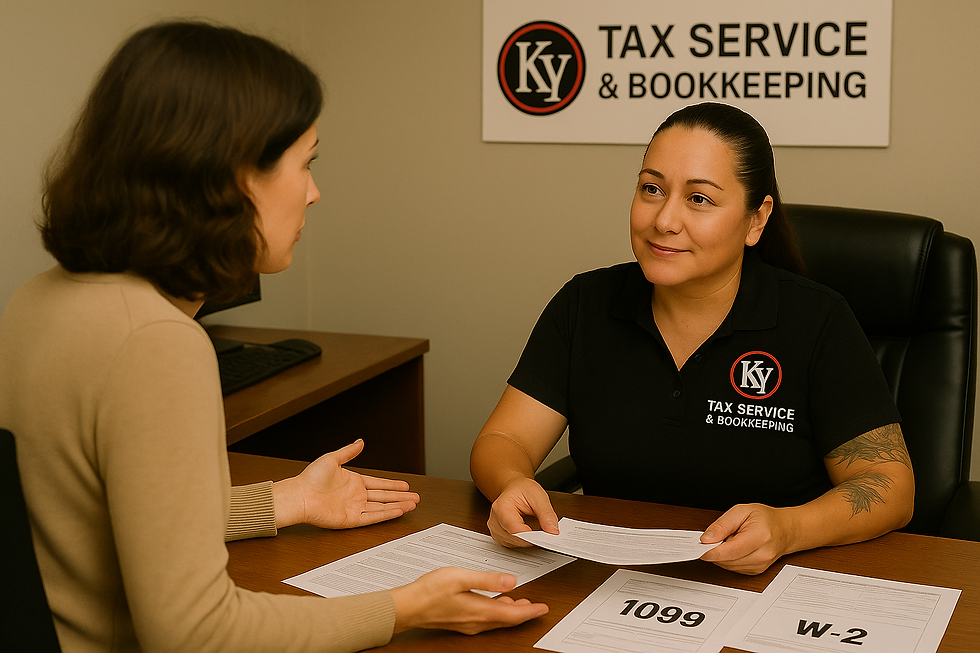
Our team specializes in bookkeeping services near San Martin and tax compliance. We can:
Conduct full classification reviews
Draft proper contractor agreements
Help file VCSP forms and avoid major penalties
If you ask yourself, What Happens If You Misclassify Your Employees vs. Contractors and If you’re unsure, don’t wait. Your risk increases with every paycheck.
Conclusion: Don’t Risk It. Get It Right from the Start
Misclassification may seem like a harmless mistake, but the costs add up fast. In California, with aggressive enforcement and strict legal standards, the safest route is proactive compliance.
Whether you’re a small business owner in Morgan Hill or a tech startup in San Jose, KY Tax Service & Bookkeeping can help ensure your worker classifications are clean, compliant, and audit-proof.
Frequently Asked Questions
What are the penalties for misclassifying an employee?
Penalties include IRS fines, back taxes, unpaid benefits, and up to $25,000 per violation in California. In some cases, criminal charges may apply.
How can I determine if someone is a contractor or employee?
Use the IRS Common Law Test and California’s ABC Test. The more control you have over a worker’s schedule and tools, the more likely they are an employee.
What happens if the IRS audits my worker classifications?
They’ll assess back taxes, issue penalties, and possibly flag other tax issues. You may lose deduction privileges and face payroll liabilities.
Can misclassification be accidental?
Yes. But even unintentional misclassification can lead to steep penalties. That’s why it’s important to review classifications annually.
How can I fix misclassification issues?
Use IRS Form SS-8 or the VCSP program to correct status. Working with a tax advisor is your safest route to avoiding or reducing penalties.


Comments